
2020 has been a pretty hard year for people around the world. With the spread of the Covid-19 virus, economies were basically halted across the entire globe, and most of the world’s citizens have felt the impact of this pandemic in one way or the other. Economic disparity has always been an issue society has faced and either dealt with or have let fester in our world and while everyone may have their own opinion about economic disparity and it’s causes, the data surrounding the economic shift during this pandemic is fact. The purpose of this data driven story is to convey the absurdity of such a high margin to the average viewer who may not put that into perspective simply off of face value and use data and data visualization to help put the pieces of the puzzle together.
Not everyone has felt the economic weight. The higher the economic latter, the less an individual or family feels when it comes to the effects of Covid-19 on the economy. “In the US, wealth – which includes savings, investments and the prospect of inheritance – is divided unequally. The wealthiest 20% of Americans have 90% of the pie. The poorest 20% are $6,000 in debt”. (Jonathan JB Mijs)
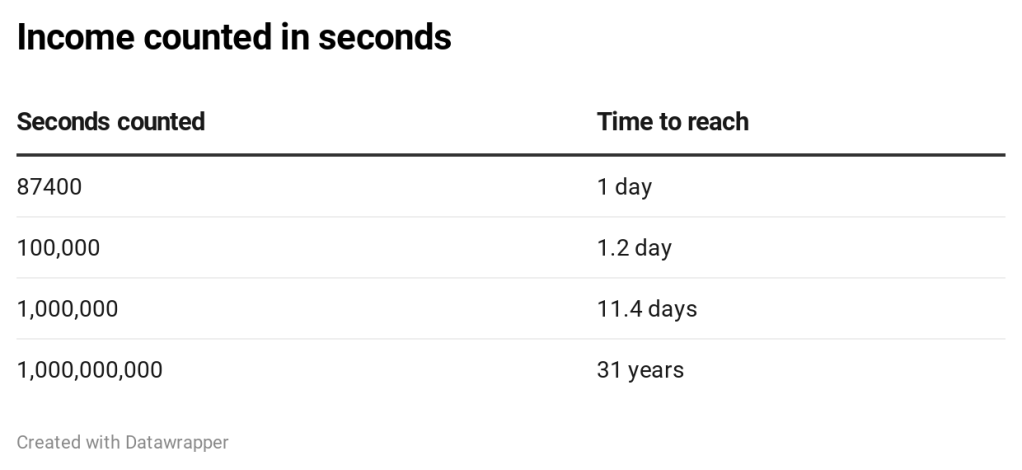
So, let’s put 1 billion dollars in perspective. It’s hard to imagine several past a certain amount, and things start getting pretty crazy once we enter the millions range in most of our minds, but the different between a million and a billion is absolutely staggering. Most of us can count our salaries in a single day. It might take half the day, or a full day of non-stop consecutive counting, but even if you make over 100k, don’t expect to even count for more than 2 days if it was possible to count non-stop every second for entire 24-hour periods. Spoiler alert: It’s not. But say it was possible, this is how it would break down.
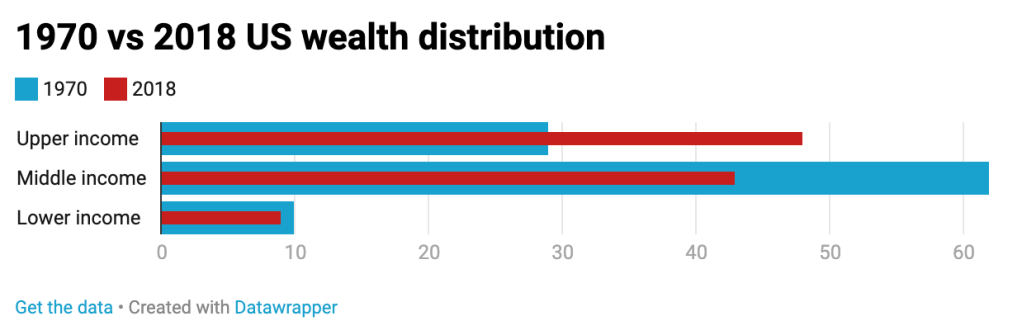
Throughout the decades, the poorest 50% of the country has seen its wealth remain stagnant or even fall while there has been a steady increase in the top 20 percent or earners with the middle class shrinking in size at the same time. The pandemic has only added to that disparity with an additional 10% increase in wealth to the top 1% of earners. “Between 18 March and 10 April 2020, over 22 million Americans lost their jobs. Over the same three weeks, my co-authors and I find in a new study for the Institute for Policy Studies, US billionaire wealth increased by $282 billion — an almost 10 percent gain”. (Collins)
With the most economically vulnerable among us positioned to lose the most in during this pandemic, it’s disturbing to see that while the top 1% of earner’s wealth increased 10% during the first months of the pandemic, overall household wealth across all economic classes decreased by around 6 trillion. “Over the first three months of this year, households experienced a wealth loss of $6.5 trillion. All of it (and then some) came from a $6.9 trillion drop in financial assets, offset by gains in home equity at the same time”. (Weller)

With all this information at hand it seems disturbing that the economy would favor those in already economically comfortable positions over the majority of people who live at or below the poverty line. It affects all aspects of our economy, overburdens the healthcare system, especially when we are facing historic numbers of unemployment, and healthcare is usually tied to your place of employment. More should be done to help those in need, and it’s time that we as a society address economic inequality once and for all, even if it was a pandemic that accelerated the process to create a more feasible and sustainable economy.
Resources
Jonathan JB Mijs, The Conversation. “The Covid-19 Pandemic Has Exposed the Deep Inequality in the US.” Scroll.in, Scroll.in, 30 Apr. 2020, scroll.in/article/960570/the-covid-19-pandemic-has-exposed-the-deep-inequality-in-the-us.
Collins, Chuck. “Let’s Stop Pretending Billionaires Are in the Same Boat as Us During This Pandemic.” Institute for Policy Studies, 24 Apr. 2020, ips-dc.org/lets-stop-pretending-billionaires-are-in-the-same-boat-as-us-during-this-pandemic/.
Sawhill, Isabel V., and Christopher Pulliam. “Six Facts about Wealth in the United States.” Brookings, Brookings, 28 June 2019, www.brookings.edu/blog/up-front/2019/06/25/six-facts-about-wealth-in-the-united-states/.
Weller, Christian. “Households Lost $6.5 Trillion In March, But The Decline In Average Americans’ Wealth Has Only Begun.” Forbes, Forbes Magazine, 19 June 2020, http://www.forbes.com/sites/christianweller/2020/06/19/households-lost-65-trillion-in-march-but-the-decline-in-average-americans-wealth-has-only-begun/.
Bureau, US Census. “Income Inequality.” The United States Census Bureau, 21 July 2020, www.census.gov/topics/income-poverty/income-inequality.html.
CBS News. “How $98 Trillion of Household Wealth in America Is Distributed: ‘It’s Very Depressing.’” CBS News, CBS Interactive, 31 Jan. 2020, www.cbsnews.com/news/income-inequality-in-america-how-98-trillion-of-household-wealth-is-distributed/.
USAFacts. “Wealth in America: Inequality Persists in Household Wealth.” U.S. News & World Report, U.S. News & World Report, http://www.usnews.com/news/elections/articles/2019-11-14/wealth-in-america-inequality-persists-in-household-wealth.

 Design By Angel Vazquez