
Social media, the glue that binds society together in the digital world. This week’s project involves a weeklong “detox” project quitting something you do on a daily basis in order to make more room and time for deep work. The main objective here is not only data collection and analysis, it is also a process of understanding and implementing the discipline necessary to cut off all distractions including our favorite social media tools, in order to focus on tasks and priorities that need to be taken care of before allowing ourselves to return to our leisure, and entertainment.
Snap chat is an app that I use to connect with my friends, and to share pictures or conversations in a fun way. It also serves as a platform that shares stories about current events and is used by millions of people. It can be a distraction because of the nature of how the app works. Friends can message you or send you pictures and when you are in deep work, it can affect your performance by distracting you and taking you out of the moment when you are focusing on getting any school and or work project done. Being that it is a distraction, I decided to give it up for 5 days and collect data on my time without using this app.
Collecting data for this project is important because it allows us to see the effects of this detox in a way that is tangible. Is this process worth it? Is it an idea that can be consistently used, and does it affect the user positively? Data allows us to answer these questions. For the purpose of this project, qualitative data is the most ideal form of data collection. “Some of the methods covered here are quantitative, dealing with something that can be counted. Others are qualitative, meaning that they consider factors other than numerical values. In general, questionnaires, surveys, and documents and records are quantitative, while interviews, focus groups, observations, and oral histories are qualitative. There can also be crossover between the two methods”. (Quentin Ainsworth)
While the type of data collection used will be a hybrid of both quantitative and qualitative data, the main data collection method will be a diary study. “Diary studies involve the standard tasks of any research project: reviewing the literature and identifying research questions; designing and carrying out a data collection protocol; and analyzing and discussing the data. (Lauri L. Hyers)
During the course of this diary study, the number of days without using Snap chat, the amount of potential distracting messages received, and the amount of times distractions were offset by ignoring snap chat were recorded. Using this method, it will show how much of a distraction over the course of 5 days snap chat can be while setting myself up for deep work and the mentality required to achieve that goal. The data collected confirms that social media is a big factor in distracting students and workers when attempting to focus on a task. It shows that part of having a deep work mindset will require users to develop the discipline necessary to avoid and ignore digital distractions as well as in their own environment when creating and working in a space dedicated to deep work.
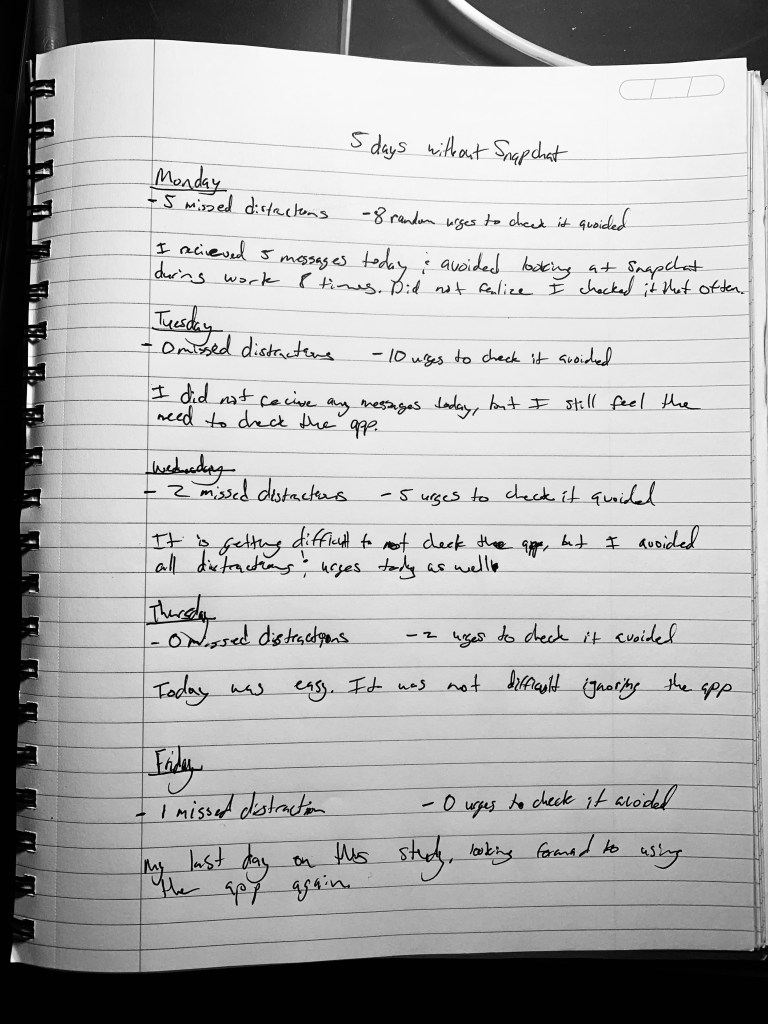
The study was started on Monday and finished by Friday. In total, there were 8 missed messages, and 25 different occasions where the urge or impulse to open and check the app were avoided. The main take away was seeing how many times a day this was distracting and detracted from time that could be used for focusing on something 100%. This is just one app however, and a diary study should be done with social media in general, or even not using a phone other than to receive phone calls for 5 days. Our day to day lives are full of so much distraction that just seeing how changing one thing can make such an impact is impressive.
This was an interesting study. Writing down every time you avoid opening the app to check for a message, or just simply out of habit shows us how we are affected by technology. The method chosen does give great insight and felt like the right choice when conducting this experiment. “Qualitative researchers choose diary methods for many good reasons. When participants record their observations or perceptions in the moment, we learn something different about their experiences than might be gained from other methods. Sometimes private reflections are more candid, and participants might feel more able to express themselves in a diary than in an interview”. (Janet Salmons) I understand more now how to deal with and avoid distracting myself by being aware of that fact when it happens, as well as building the discipline necessary to not let social media distract me when I need to stay focused.
Resources
Ainsworth, Quentin. “Data Collection Methods.” JotForm, www.jotform.com/data-collection-methods/.
Hyers, Lauri L. “Diary Data Collection as a Qualitative Research Method.” Oxford Scholarship Online, Oxford University Press, www.oxfordscholarship.com/view/10.1093/oso/9780190256692.001.0001/oso-9780190256692-chapter-2.
Salmons, Janet. “Diary Methods.” MethodSpace, 27 Aug. 2018, http://www.methodspace.com/diary-methods/.

 Design By Angel Vazquez