
Creating a “How might we” statement was an interesting exercise in thinking outside of the box. While overall, I felt that this exercise was beneficial, I also overlooked how difficult it could be when it comes to brainstorming and ideating two different ideas and mashing them together into a statement that can potentially be beneficial to the main objective. For designers as individuals or in teams, “How might we” statements, otherwise known as challenge mapping, create a different way to think about the problem or task at hand. It also allows for inclusion of differing perspectives creating greater teamwork among design teams.
My big take away from this kind of ideation technique is that it was created to ensure you really think about differing solutions, while ensuring you don’t overlook any potential ideas you currently are not focused on. While this and several other UX ideation techniques may seem new, they have been developed over the course of decades. “Although the HMW process has been used at IDEO for a number of years, its origins can be traced back to Basadur and his early days as a creative manager at Procter & Gamble. In the early-1970s, the company’s marketers were working themselves into a lather as they tried to compete with Colgate-Palmolive’s popular new soap product, Irish Spring, which featured a green stripe and an appealing “refreshment” promise”. (Warren Berger)
With the necessary information about how this technique works, I started by posing my statement: How might we incentivize people to become greener/eco-friendly? I chose this statement because I thought it would be a problem to ideate and see if any solutions could be found throughout the process. For the next part, I had to think of two opposing or simply different ideas that can be used to solve my “how might we” statement. The point of this is to start brainstorming ideas and using those two sets of different ideas to start fusing them together into 1 cohesive idea that relates to what was the problem statement, turned into a “How might we” statement. After figuring out what would be on both lists, it was time to put together these ideas into mash up definitions or statements.
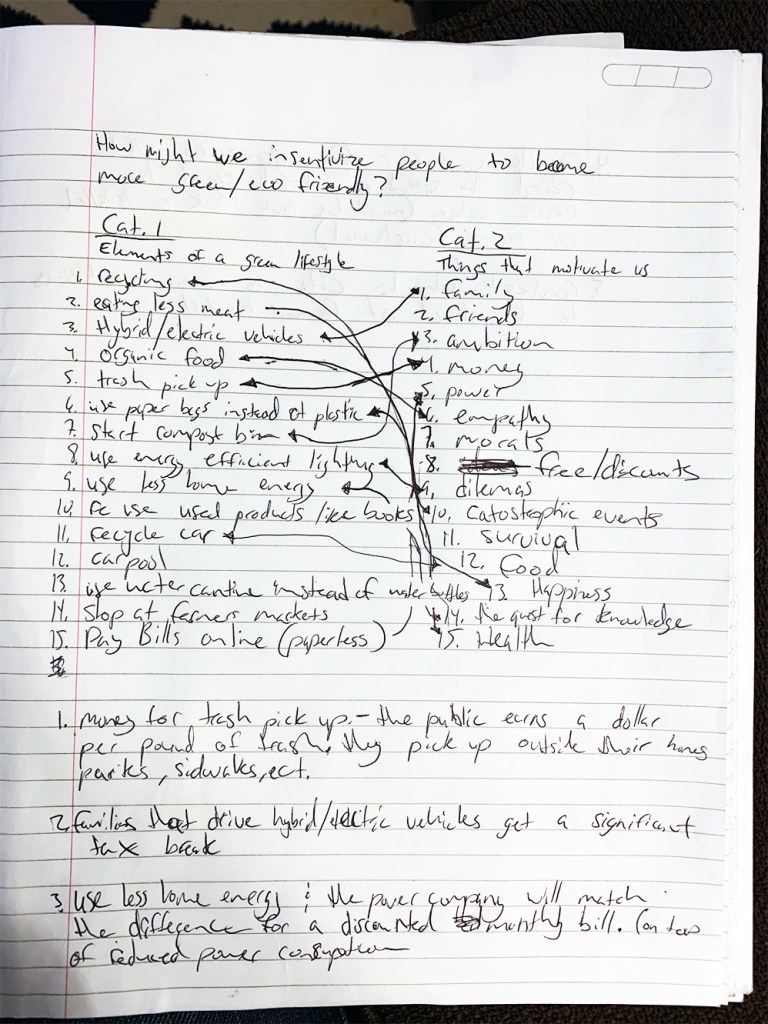
Here are the 5 I statements I created:
- Money for Trash Pickup – The public earns a dollar per pound of trash. They pick up outside their homes, parks, sidewalks, and turn it in in large trash bags that are then weighed for money. Creating a trash economy in the process.
- Families that drive hybrid/electric cars are given a tax break for as long as they have the vehicle. (something like this is already in practice).
- If you use less electricity at home, the power company will match your decrease to provide a substantial discount to your monthly bill.
- Recycle your car for grocery gift cards to spend on food equal to the car’s value (must be over 100k miles, totaled, or non-functional.
- A contest: Which city is more ambitious to be greener by buying local at farmers markets instead of chain supermarkets and stores. Prizes may vary from state to state.
While some of these ideas may already be implemented, it goes to show you that this method helps us as designers think outside of the box but remain focused on the task at hand. As with other parts of UX methodology, ideation creates a mental space where we can pull ideas from abstraction and create tangible ideas, methods, or designs. It’s a crucial part of the UX process and while this exercise wasn’t directly UX related, it demonstrated how effectively it could be used in the real world.

 Design By Angel Vazquez